

From Gold to Code—and Back Again
Parallels Between 1929 and Today’s Financial Fragility

“The only thing we have to fear is fear itself.” – Franklin D. Roosevelt, 1933
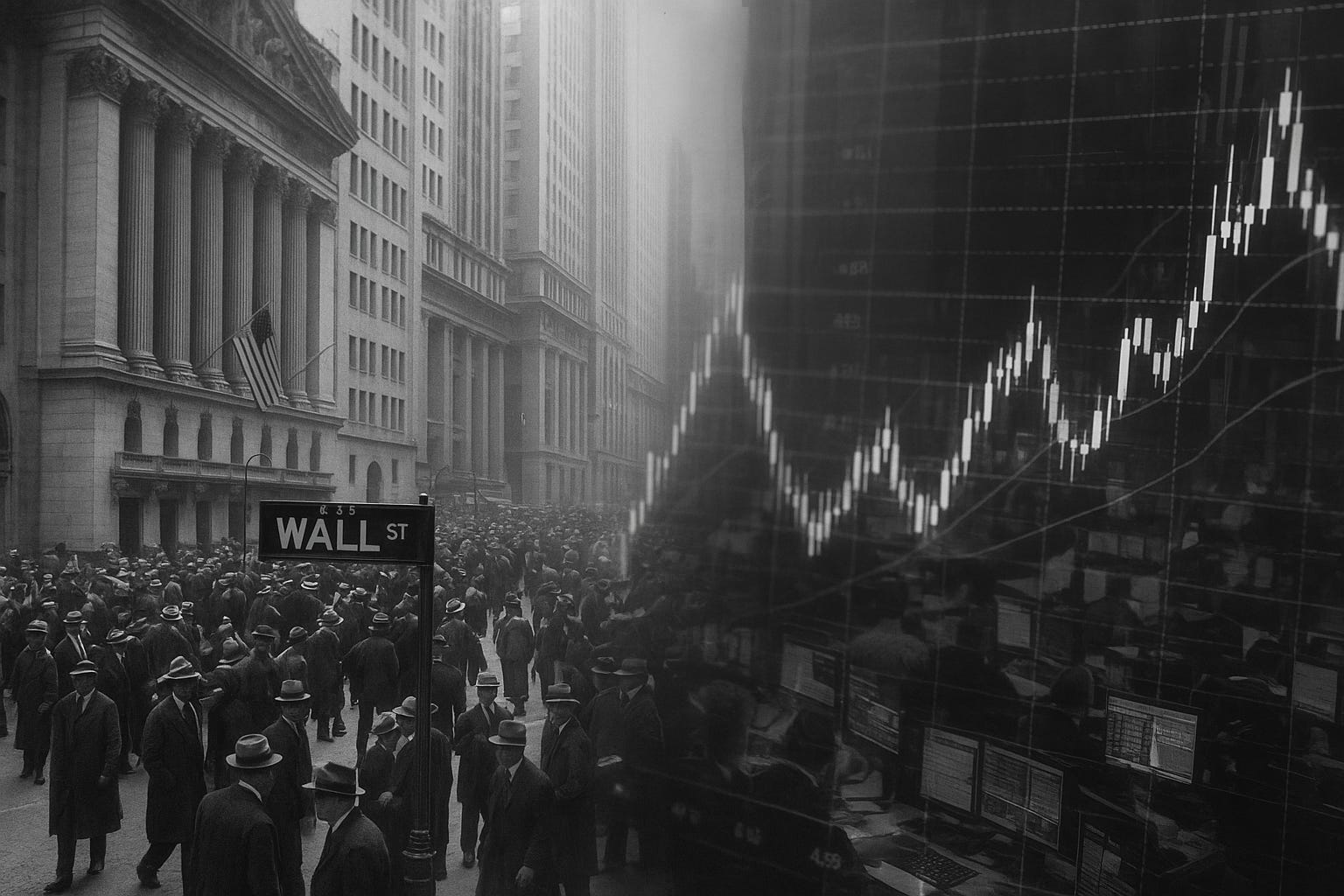
In the final months of 1929, America looked unstoppable. Cities glowed with electric light. Streets swarmed with automobiles. Radios carried jazz, ball scores, and a steady stream of stock tips into living rooms across the country. Skyscrapers rose like monuments to a future that seemed permanently bright.
Progress wasn’t just a hope—it had become a national badge. Factories ran around the clock, credit flowed freely, and speculation seeped into everyday life. The stock ticker didn’t merely report trades; it pulsed like the heartbeat of a country convinced the boom would never end.
It was in this climate that the shoeshine-boy story spread. Joseph P. Kennedy recalled receiving stock tips from the boy polishing his shoes on Wall Street. If even a shoeshine boy had become a market sage, Kennedy reasoned, the mania had topped. He stepped out in time, but most investors didn’t. The lesson: what feels permanent is often already changing.
Behind the optimism, leverage was quietly piling up. Brokers issued margin loans that covered nearly the entire cost of a stock. Banks speculated with depositor money. Borrowed dollars, not rising productivity, powered the boom. Markets looked strong, but the foundation was weak—and the reversal hit fast.
Over three brutal days—Black Thursday, Black Monday, and Black Tuesday—fortunes evaporated. The Dow Jones Industrial Average plunged from a September peak of 381 to just 41 by mid-1932. Banks collapsed, credit froze, and the trust holding the system together vanished almost instantly.
One asset didn’t buckle: gold. Because the dollar was tied to gold, the metal kept its credibility even as paper claims failed. Shares of Homestake Mining climbed through the Depression and continued paying dividends. Gold held firm for a simple reason—it was tangible, scarce, and immune to panic.
From Tangible to Digital
The America of 1929 ran on physical output—manufacturing, agriculture, construction. Services existed to support the industrial base, not dominate it. Trade moved at the pace of rails and telegraphs.
Today, the structure is almost reversed. Services—finance, healthcare, education, technology—now drive the economy. Manufacturing is a fraction of its former scale; agriculture barely registers in national income. The United States runs not on assembly lines but on data centers, software, and financial engineering. The economy relies on code, contracts, and liquidity.
Modern crises unfold differently. They don’t close factories—they tear through credit markets, risk models, and algorithmic trading systems. A sell-off in one market can ricochet around the globe in seconds. The physical economy no longer restrains finance; more often, finance shapes the physical world.
This shift has changed the nature of fragility. The early 20th-century gold standard imposed constraints that deepened downturns but also anchored the dollar. Today, money creation is a political act, not a geological one. When governments issue debt or central banks expand their balance sheets, they do so by perceived authority, not by physical scarcity.
History’s most extreme inflations—from Weimar Germany to Zimbabwe—show how quickly credibility collapses when leaders borrow without restraint. Over time, debt claims multiply faster than the economy’s ability to generate real value. Markets drift from earnings to expectations. Prices depend less on current output and more on the hope that someone else would pay more tomorrow. The gap between what the economy produces and what the financial world promises widens.
With public and private leverage at record levels, the system now depends on steady liquidity. It functions only as long as credit and energy remain cheap, and investors stay calm. Gold, which grows slowly and only through physical labor, exposes that tension. It doesn’t respond to politics or promises, but to forces beyond central control.
Central banks seem to recognize this. They’re buying gold at the fastest pace in decades—a quiet acknowledgment that a world built on expanding IOUs still needs something solid beneath it. The dollar remains the world’s reserve currency, but after decades drifting from metal toward abstraction, code is now making way for gold once more in the emerging world order.
If a Crisis Hit Today
If a severe financial shock struck now, the winners and losers would likely reflect the modern reversal in risk:
Likely winners:
Gold and other metals
Real assets
Short-term cash instruments
Likely losers:
Highly leveraged financial firms
Speculative real estate
Unprofitable tech companies
Capital-intensive digital infrastructure
Modern leverage is built for speed. Derivatives, options, margin debt, and high-frequency algorithms can turn panic into collapse in seconds. Globalization magnifies every tremor: a crack in one market sends shocks around the world. When too many financial claims chase too few real assets, power ultimately returns to what cannot fail.
The Limits of “Digital Gold”
Bitcoin is often called “digital gold,” but the comparison is misleading. Gold stores the energy required to extract it. Bitcoin, by contrast, consumes energy merely to keep its network running. Gold’s scarcity is physical; Bitcoin’s is mathematical. And because Bitcoin depends on the electrical grid—funded by taxes, debt, and subsidies—it remains tied to the very system it is supposed to replace.
Put differently: gold is real, heavy, and independent; Bitcoin is digital, abstract, and dependent. One exists in the physical world; the other exists inside the system built on the physical and financial world. If the global infrastructure or trade networks falter, Bitcoin cannot function. Bitcoin may be innovative—even revolutionary—but it is not independent of modern infrastructure. It lives within the fragile system, not outside it.
Conclusion
History’s lesson is clear: financial systems are only as resilient as the foundations beneath them. In 1929, tangible assets anchored value. Today, much of the economy exists in code, contracts, and leverage. Gold reminds us that some forms of value are independent of perception, politics, or software. Modern digital assets, while impressive, remain tethered to the very system they aim to replace.
As in 1929, human optimism inflates, leverage multiplies, and fear eventually returns. What we choose to anchor our faith to—gold, code, or something else entirely—may determine whether the next crisis is a fleeting panic or a system-shattering collapse. Roosevelt’s warning echoes as strongly today as it did in 1933: the only thing we have to fear is fear itself—but fear, in a world untethered from reality, has a way of arriving faster than we imagine.
If this analysis resonated with you, please consider liking and sharing it. And if you’d like to support my work—enabling deeper research and essays like this—I invite you to join me on Patreon, BuyMeACoffee, or Substack. Your support allows me to continue writing full-time and expanding this project into something truly meaningful.
References
Federal Reserve History. Stock Market Crash of 1929.
Friedman, M., & Schwartz, A. J. (1963). A Monetary History of the United States, 1867–1960. Princeton University Press.
Jastram, R. W. (1977). The Golden Constant: The English and American Experience, 1560–1976. Wiley.
Romer, C. D. (1999). “Changes in Business Cycles: Evidence and Explanations.” Journal of Economic Perspectives, 13(2), 23–44.
Carter, S. B., et al. (Eds.). (2006). Historical Statistics of the United States: Earliest Times to the Present. Cambridge University Press.
This new Peter Schiff video ties in well with your analysis:
https://www.youtube.com/watch?v=a2_Qkn105dA
Retrospectively, I wish we had the genuine and productive resources available to us in 1933 then the depleted and fragile ones of today. Now, a mere shadow of a stand-in exists in comparison. Ephemeral resources drowning in debt won't cut it. It's hard to escape a sense that something ominous lies ahead. Thanks Wendy for another reality check.