


“A culture that is locked into the left-hemisphere version of the world is, for all its successes, a tragic culture: a culture that is lonely and lacking in meaning, that is unwelcoming to others, and strangely dead to the beauty and mystery of the world.”
— Iain McGilchrist, The Master and His Emissary
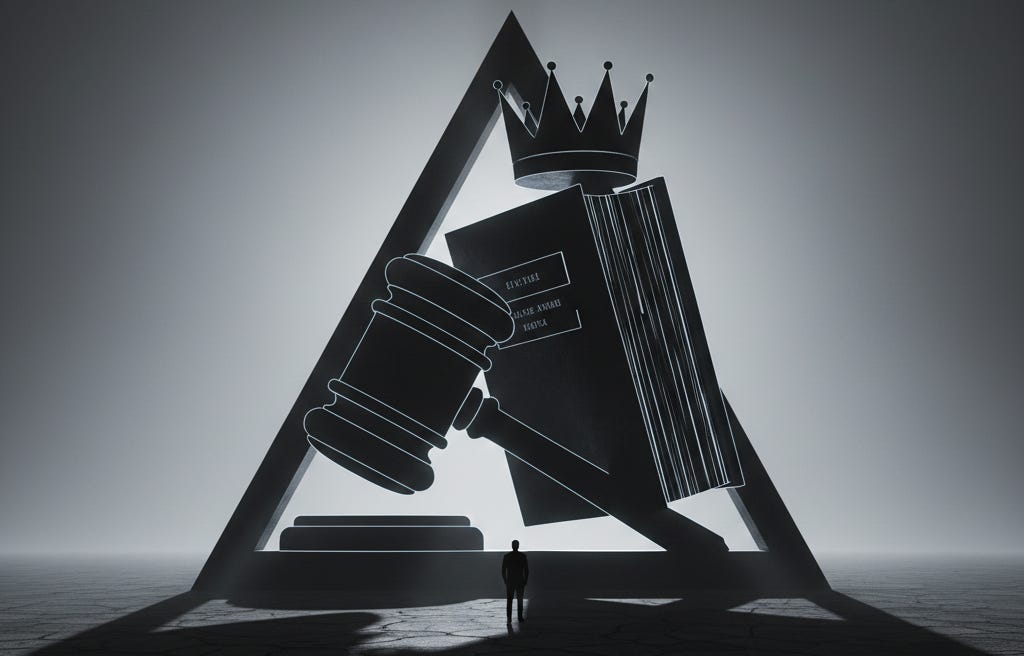
The First Thing Built
The first thing built was a line.
Not a wall, not a tower—just a line drawn to separate this from that. Useful from useless. Safe from dangerous. Mine from not mine. Once the line held, another followed. Then another. The world began to resolve itself into parts that could be arranged.
They stacked stone because it could be stacked. They counted numbers because they were there to be counted. And they divided time—because division made it manageable. What could be measured could be predicted; what could be predicted could be controlled. And what could be controlled invited expansion.
Villages took root where patterns could be repeated. Then cities grew where those patterns could be enforced. Roads straightened the land. Grids flattened complexity. That’s when the vertical truly emerged—structures reaching upward, each one an insistence on permanence, on visibility, on dominance. Height became meaning.
Each generation inherited the previous layer and added one more. Tools improved. Plans grew more intricate. The view from above became preferable to the view from within. Distance replaced intimacy. Abstraction replaced presence.
Stone gave way to brick, then brick to steel, then steel to glass. But the motion never changed. Always taller. Faster. More efficient. The living world was reduced to units, then inputs, then data. Humans learned to think the way their structures stood—upright, rigid, directional.
There was always another level to add. Another system to optimize. Another framework to perfect. Stopping felt like failure. Pausing felt like falling.
What was built externally mirrored what was built internally: a mind trained to dissect rather than dwell, to solve rather than sense, to rise above rather than remain with. Complexity became something to conquer instead of something to hold.
And then the tower rose in thought itself.
It scaled into cultural engineering.
It built the first city.
It became the first algorithm of violence.
One tower, then another. Then three.
Do you remember the number three—not in counting, but in feeling?
Cain.
Cities.
Empires.
Always.
Meet the Builder
To understand the Left Brain’s trinity, you first have to meet the Builder.
But this is more than a mental function. It’s a personality. Its core desire is to escape the vulnerability of being human by constructing something permanent, controlled, and glorious—a monument to its own understanding. It doesn’t just think; it builds.
And what it loves to build most of all are towers: structures so unified and imposing they promise safety from uncertainty itself.
This personality has been running the same playbook for millennia. Its history reveals a repeating arc of ambition, consolidation, and collapse.
The First Tower: Babel
(~1,700–2,000 years after the Fall)
The blueprint appears early.
After the Flood, humanity gathers on the plain of Shinar. Faced with the fear of being scattered, they say: “Come, let us build ourselves a city, and a tower with its top in the heavens, and let us make a name for ourselves.”
Here, the Builder stands fully revealed: one language, one purpose, one single project—security and meaning achieved through unified construction. Babel is not merely a city; it is a totalizing spiritual system, designed to replace relationship with consensus and transcendence with scale.
Its collapse comes not through catastrophe, but through difference—the very plurality it tried to eliminate.
The Second Tower: Rome
(~1,700–2,000 years after Babel)
The Builder learned. And then it scaled.
Rome perfects Babel’s logic. One law. One road system. One currency. A vast administrative machine promising order, peace, and predictability from Britannia to Syria. The Pax Romana is the ultimate left-brain assurance: safety through structure, unity through management.
Its tower was built of marble, legions, and law—a system so refined it whispered of eternity. And yet it is built on the same exile logic—peace through domination, meaning through monument, unity through imposed sameness.
Its collapse comes from within: bureaucratic exhaustion, moral hollowing, the weight of its own complexity. Even the most brilliant system cannot generate the soul it seeks to contain.
The Third Tower: Christendom
(~1,700 years ago to now)
Then came the most tragic turn.
In fifteenth-century Spain, with the doctrine of limpieza de sangre—“purity of blood”—Christendom committed its cardinal error. It declared that Jewishness was a hereditary taint, a biological condition beyond the reach of sacrament, faith, or God’s own transformative grace.
This was not Christ. This was something else entirely.
Here, the Builder crossed a final threshold. The living covenant was overridden by bureaucratic logic. The person was reduced to a category. The system rendered its ultimate verdict—and, in doing so, wrote its own suicide note: bureaucracy could override grace.
Calling this a theological mistake misses the point. It was a metaphysical inversion. A theology of grace was traded for a bureaucracy of biology. This conceptual poison became the original sin of modern racism, constructing the cage of racial identity and triggering the Law of Reversal—the moment a system built to save begins to damn.
This was the Second Fall.
A repeated exile from the Garden.
The Church inverted relationship back into architecture. It became a new Rome—a Babel reborn—erecting a holy tower of dogma, hierarchy, and sacred territory. The vulnerable power of the cross was exchanged for the coercive power of the crown.
From the Council of Nicaea (325 AD) to the present moment spans roughly 1,700 years.
The tower technically collapsed with World War I—the last gasp of Christendom’s imperial form. But collapse does not mean disappearance. The Builder rarely leaves. It renovates.
How the Builder Escaped the Incarnation
After the Playwright entered the story—after the twelve archetypes of fractured consciousness were recast in love and trust—there was already a leak: Judas. Not a villain, but the Builder’s final calculation—an attempt to manage grace through transaction, leverage, and control.
Think of Judas as the hollow empire in miniature. He is the exhausted ledger, the man who believed even love must be accounted for. Here converge the fractures of relationship, power, and identity into a single, devastating transaction. He is Cain’s ledger, Saul’s paranoia, and the Pharisee’s audit—fused into one man holding a money bag. His betrayal wasn't random greed. It was the systemic output of a consciousness that could only relate to its Messiah through the Builder's cold calculus. Unable to enter the recasting, he exits through self-destruction—but even he is touched by resurrection.
Following Pentecost, the fledgling church again faced persecution and scattering. At Nicaea, the Builder’s tools were consciously adopted: definitive doctrine to regulate belief, canon law to regulate behavior, imperial alliance to regulate belonging.
The pattern is precise, repeatable: a long arc of construction, followed inevitably by collapse.
The Architecture of Control
Over time, the Builder’s logic hardened into a reliable toolset: a Left-Brain Trinity. Three systems of control, each engineered to answer a profound human fear.
Doctrine — Creed as Control (Control of Meaning)
The fear of the unknown.
Here, complex truths are shrunk into portable slogans—easy to spread, to prove, to police. The open hand of wonder is replaced by the closed fist of certainty. An inner conviction is outsourced to a public ritual. If you can measure it, you can manage it.
Law — Rule as Certainty (Control of Behavior)
The fear of chaos.
Here, judgment is replaced by protocol. Autonomy is traded for safety. Wisdom is overruled by policy. Ultimately, human trust is outsourced to a technical fix—the fact checker’s green checkmark.
Empire — Power as Security (Control of Belonging)
The fear of the Other.
Here, belonging is decided by walls, hierarchies, and force. Vulnerable togetherness is traded for fortified security. Your place is no longer earned by relationship, but assigned by power.
Every great civilization is a compound of all three. Yet each constructs its central tower around a single dominant limb, organizing the entire edifice according to that primary logic of control.
One Fracture, Three Worlds
Judaism — Law as Center
Answering the fear of chaos.
After exile and loss, the Jewish people forged an identity not tied to a place, but to practice—a way of life you could carry anywhere. Big theological questions were often left open for debate; political empire was held at arm's length. Instead, the detailed guidance of religious law became a portable homeland, a shelter of certainty. The quiet danger was that in maintaining the shelter so carefully, the rules could eventually become more important than the spirit they were meant to protect.
Christianity — Doctrine as Center
Answering the fear of the unknown.
Under pressure to define itself, Christianity distilled its core experience of radical relationship into formal statements of belief. Correct belief, rather than shared lineage or practice, became the key marker of belonging. The freely given gift of divine grace was structured into a system that could be taught, measured, and mediated by the institution. What began as a spiritual revolution slowly became Christendom—an administrative framework for overseeing the path to salvation.
Islam — Empire as Center
Answering the fear of the Other.
In Islam, faith, law, and political rule were woven together from the beginning into one seamless blueprint for society. Authority here was not just about command and control, but about integration—creating a unified vision that organized every aspect of existence, from worship to commerce to governance.
These are not families. They are rival specializations of the same fracture. Each one claims wholeness. Each demands defense. And each is destined, inevitably, to collide.
That is the cost of replacing relationship with architecture.
The Center and the Way Through
You and I live inside the latest, most polished version of our fractured consciousness. Today, the Left-Brain Trinity doesn’t just rule empires or churches—it’s been secularized, digitized, and wired directly into our nervous systems.
Doctrine is now the endless performance of curated certainty—in our feeds, our hot takes, our need to always be right.
Law is the algorithmic logic that reduces human complexity to data points for compliance and profit.
Empire is the relentless pressure to brand ourselves, monetize our identity, and secure belonging in a marketplace of competing tribes.
Our politics feels like a screaming match because it is—two wounded halves of the same fractured consciousness, fighting over how to manage a tower that is already crumbling from within.
But our true Center was never lost.
We overwrote the Playwright’s story of intimate, self-giving love with the Builder’s program of control. Christ—the living source code of reality, Love in flesh and bone—never left the stage.
We turned our backs. We crowned ourselves, ran the Builder’s script on a loop, and repeated it until the output degraded into noise: the sovereign self, the transactional relationship, the hollow interior of a tower that can only feed on itself.
Now that program is failing. And in the quiet exhaustion it leaves behind, the original, living alternative is becoming visible again.
The problem was never Christ’s absence. It was our sustained decision to drown Him out with the Builder’s noise. His return, then, is not a discovery of something new. It is a resynchronization with the Love that was always, patiently, here.
The way out is not forward or backward. The answer is not to destroy the Left Brain or the Builder—its genius for creating structure is real and needed. But left unchecked, building becomes a closed loop. A tower.
Reintegration is the healing.
This is the original logic of wholeness: the physics of self-giving love. Its ancient and living name is Christ. It is structure serving relationship. Skill protecting presence. Safety found not in higher walls, but in deeper trust.
And it begins right where you live.
When productivity tries to replace joy.
When a relationship slips into the ledger of accounting.
When isolation masquerades as safety.
His return is kenosis—a letting-go.
The path home is paved with small, subversive acts of reintegration: choosing presence over performance, curiosity over certainty, generosity without keeping score. It is allowing the Builder’s tools to be retooled by the Playwright’s hands.
We aren’t just living in a troubled time. We’re living inside a troubled consciousness.
To step out of its shadow is not to leave the world, but to finally see it clearly—to see the Tower for what it is, and the Center for who He is.
And from that clarity, to choose—moment by moment, stone by stone—to build something different.
Not a tower.
A home.
Sustain This Work
Crafting The Drama You’re In is a profound labor of love, demanding deep focus and independence. Every essay is the product of hundreds of hours of work, offered freely without ads. If this series has shifted your thinking and you find its perspective valuable, your support means everything. Please share this publication and, if you can, join as a paid subscriber to sustain this important work.