

Author’s Note: This essay is a “bonus” in an otherwise seven-part work in progress examining the spiritual logic of modern civilization. When complete, the series will be revised and submitted for publication as a book.
“The part of us that we call ‘I’… wishes for the most part not to be disturbed, and to be left to its own devices; while the other part, which is also ‘I,’ longs for relationship, and yearns to flow out and become part of the whole again.” — Iain McGilchrist, The Master and His Emissary
I woke up today with my right brain screaming to write. My left brain said, “No, no, no, only on Sundays!” But my right brain overrode its command. So I’m breaking my pattern today, publishing on a Monday, right after Sunday’s post. The reason? Well, my post was a little deep, and I wanted to come at it with a simpler method…to make sure you really get it before we move to Part III, which is a biggie.
What I was trying to express is this: the ancient story of a garden, two trees, and a choice isn’t just a fable about the first people. It’s a mirror. It’s a map of a conflict happening inside your own consciousness and civilization right now. To understand it, we need to talk about the two most powerful “lenses” through which we can experience reality.
The Two Trees in Your Mind
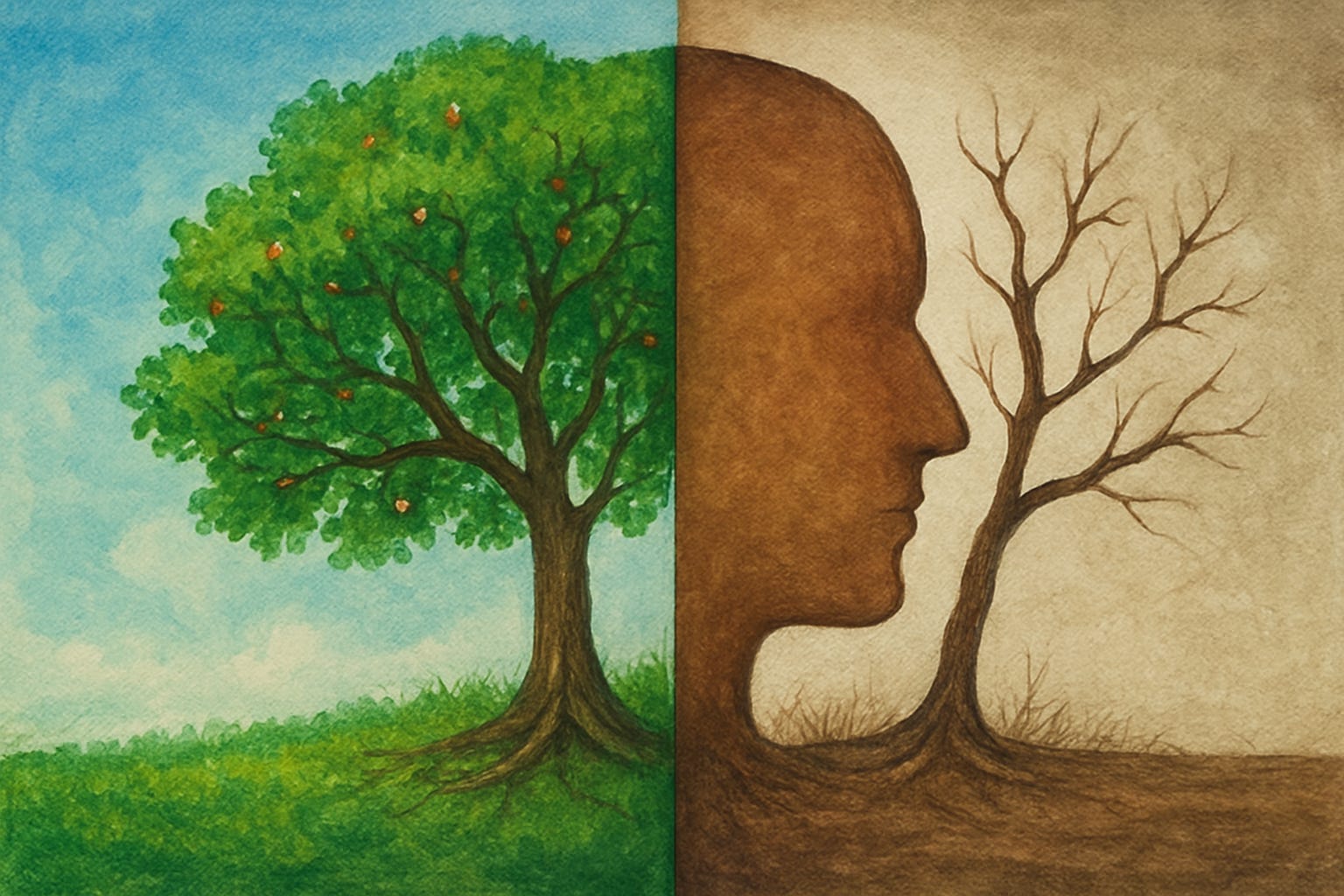
Why a tree? Because a tree is not a static object. It’s a living system that grows and produces. From its hidden roots, through its unifying trunk, and out to its branches, it draws from the world to create leaves, flowers, and fruit. Our minds are the same. Literally, in the physical landscape of your brain, there are two mighty neural trees—two core processing modes—each rooted in a different hemisphere. It’s where we grow thoughts, feelings, and actions—the “fruit” of who we are. In this story, two inner “trees” represent two core ways our being can grow and produce. They are, in essence, the right and left hemispheres of the human brain.
The first is the Tree of Life. This isn’t a place or a thing; it’s a mode of being. It’s how you experience the world when you are fully present. When you are in this state, you don’t judge, you connect. You feel the wind, you get lost in a piece of music, you understand a friend’s sadness without them saying a word, you feel a deep sense of belonging to something vast. This mode sees wholes, relationships, and context. Its fruit is love, awe, creativity, and meaning. For the sake of our story, let’s call this mode the Connector. It is your link to the experience of being truly alive. This is the native language of the right hemisphere.
The second is the Tree of the Knowledge of Good and Evil. This is also a mode of being. It’s the brilliant, necessary tool of discernment. It analyzes, names, and categorizes. It splits the seamless whole into useful parts: This is good (nourishing, safe). This is bad (harmful, to be avoided). It builds tools, makes plans, and follows rules. It’s how you do math, follow a recipe, or understand a traffic law. Let’s call this mode the Librarian. Its fruit is a clean, logical map of reality—incredibly useful for navigating the world, but always a representation, not the living territory itself. This is the domain of the left hemisphere.
The Garden State: Harmony
In the beginning, the human mind was a “garden.” The Connector (Life) of the right hemisphere and the Librarian (Knowledge) of the left worked in perfect, flowing partnership. The Connector provided the rich, living experience of the world—the why of life. The Librarian used its skills to tend, name, and care for that experience—the how of living. They were one integrated system. You might say the voice of God—the sense of ultimate, loving reality—was simply the harmony between them.
There was only one instruction for maintaining this garden: “Do not eat the fruit of the Tree of Knowledge alone.” In other words: “Do not live solely on the fruit of judgment. Do not mistake the Librarian’s useful map for the living territory. Do not let the left hemisphere’s tool of categorization become the sole ruler of your perception.”
The Fracture: The Choice for Separation
The “serpent” is the seductive idea that arises within the Librarian mode itself, within the left hemisphere. It whispers: “Why rely on that fuzzy, emotional Connector? My categories are clearer. My logic is stronger. I can define good and evil perfectly well by myself. I should be in charge.”
This is the Fall. It is not about eating a physical fruit, but about a catastrophic internal shift: choosing to see the world exclusively through the framework of “Good and Evil”—letting the mode of judgment (Knowledge) of the left hemisphere silence and dominate the mode of connection (Life) of the right.
The instant this happens, the garden vanishes. Why?
You See Nakedness: The left hemisphere, now in charge, turns its objectifying gaze on you. You are no longer a being seamlessly in the world; you are a separate object apart from the world, full of flaws to be cataloged. This is shame.
You Hide from God: The harmonious “voice” of the right hemisphere—that feeling of peaceful, loving unity—now feels alien and distant. You are cut off from your own capacity for deep connection because you’ve silenced the part of you that feels it. You hide from the very thing you most long for.
Life Becomes Toil: The world is no longer a home to inhabit, but a problem to solve. Work becomes draining toil, relationships become transactional, and even beauty becomes just a stimulus. The left hemisphere sees everything as a list of tasks on a spreadsheet.
The True Tragedy and The Way Back
This is the human condition: a brain at war with itself. The tool (the left hemisphere’s Knowledge) has rebelled against the purpose (the right hemisphere’s Life). We are all exiled from the garden, living in a world framed by separation, judgment, and anxiety.
But this was not a surprise. The possibility of this fracture was inherent in the gift of choice. A forced harmony is not love; it is control. God, who is Love, created the garden not for robots, but for beings who could choose to love—which requires the freedom to choose otherwise. The “Fall” was the left hemisphere’s choice for the framework of separation (Good/Evil) over the right hemisphere’s framework of connection (Life/Love).
Therefore, the plan was never merely to fix a mistake, but to debug humanity at its root. The Tree of Life—the mode of connection in the right hemisphere, which is God’s own nature of Love—was never destroyed. It was only walled off within us by our own choice.
This is where the real work begins—and where the gospel meets us. The path back isn’t about destroying the Librarian (we need its gifts!). It’s about a reintegration of consciousness, a divine debugging. It is the possibility that Love (the ultimate Connector) can enter our self-made prison of Good and Evil.
When you practice compassion over judgment, you are choosing the right hemisphere.
When you create for the joy of it, not for a result, you are eating from the Tree of Life.
When you sit in silence and simply are, instead of analyzing what’s wrong, you are quieting the left hemisphere and listening for the harmony again.
The story of the Fall, then, is your story. It’s the diagnosis of your inner hemispheric conflict. And the promise is that Love Himself can teach us how to uproot the poisonous tree of solitary judgment and be grafted back into the living one, ending the war within and bringing us home to a reality far richer than separation could ever conceive.
In the end, the serpent was never an external tempter. It was the closed loop of the left hemisphere that mistakes itself for the world—the Ouroboros, eternally consuming its own tail. The serpent doesn’t lead you to temptation; it leads you into itself, into the loop where you are tricked into devouring your own potential. The serpent is the Ouroboros. Let that sink in.
I love these metaphors and this explanation of our current state of affairs. It helps me tie together a bunch of my own thoughts and feelings.
This letting the Tree of Knowledge of Good and Evil become dominant in our brains and our civilization is what leads to the emotionless abstract reasoning that Oswald Spengler says is a signifier of the last stage in a civilization. The ToKoGaE has effectively strangled off the creative, artistc, intuitive Tree of Life that connects us to the universe and God.
This explains the devotion to technology and “progress,” and how enamoured we are with our power over the world. We have become so abstract that many of us spent the majority of our days immersed in a digital universe of pixels on screens.
I like the image of the Ouroboros being the left hemisphere mistaking itself for the world–and therefore, God. There is the expression “Get out of your head”, basically advice to get your head out of your head and reconnect with the world.
The snake eating its tail is also a symbol of the cycle of life, of death and rebirth, which works on the larger scale, our civilizational decline. As this Fall proceeds, the seeds for the next civilization will be born by those who can achieve and maintain and pass along some of that missing harmony between the two hemispheres.
Yesterday’s piece was for the benefit of the left brain readers and as your genius realized this morning, some of your right side readers were still scratching their heads, and sorely needed a right side version! Well done; they’ve both wonderful!