


A Three-Part Mini-Series — Part One
“They know us better than we know ourselves. That should frighten you.” — Shoshana Zuboff, Author of The Age of Surveillance Capitalism
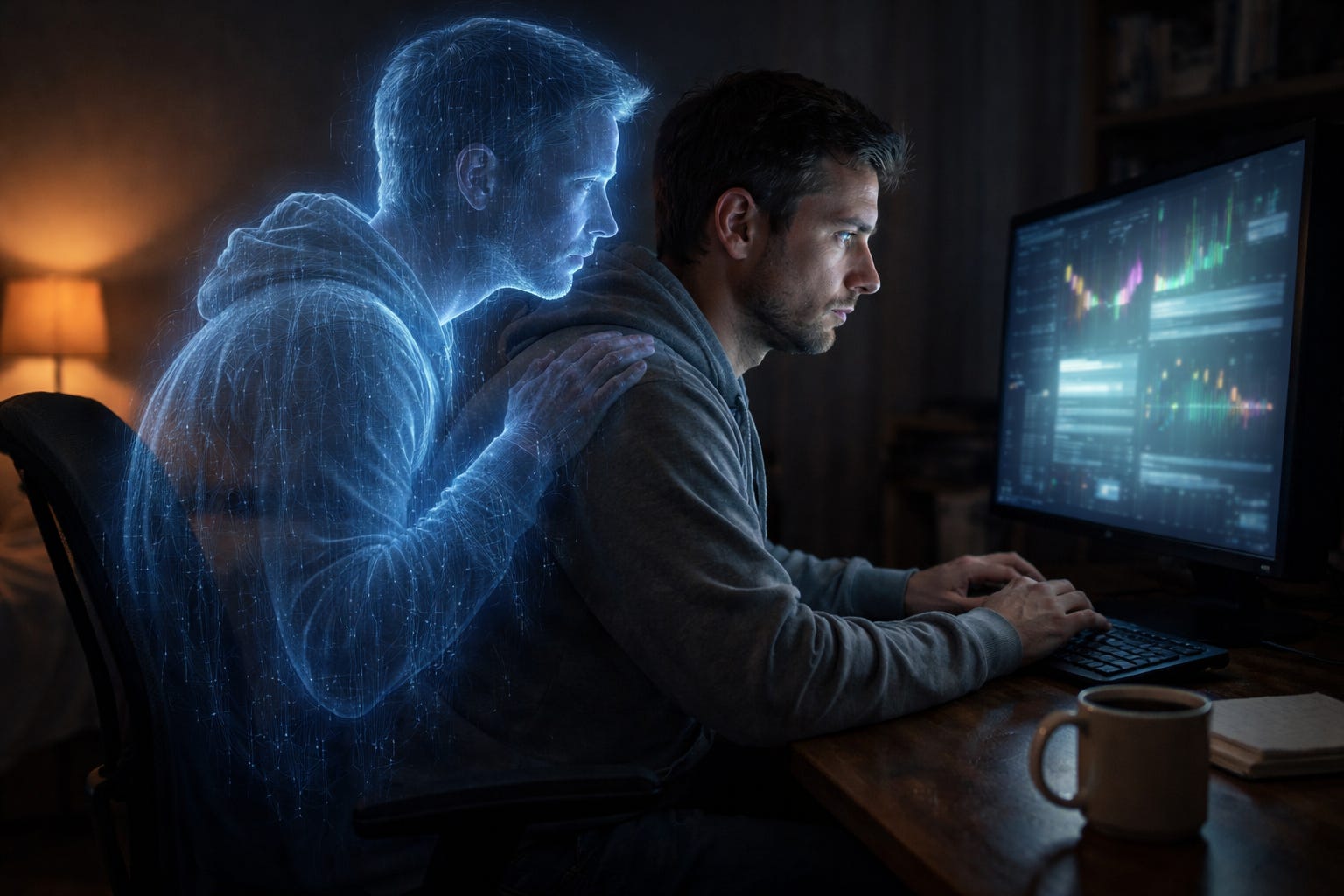
Doesn’t it give you the creeps—that you’re being studied by the minute?
Right now, somewhere yonder, a server is coalescing around your identity—your name, your habits, your fears, your impulses—fed into systems designed to know you more intimately than you know yourself.
Algorithms are mapping what captures your attention, what weakens your resistance, what shapes your beliefs, and what you are likely to believe next. Your illnesses, your prescriptions, your moments of exhaustion—harvested, categorized, valued, priced. Every search, every message, every pause becomes a digital double, a version of you that strings you tighter to the marionette’s cross.
And while this digital version of you grows—built to be manipulated, brainwashed—another system measures your limits: subtle pressures, engineered disruptions—small enough to seem accidental, precise enough to reveal how much strain you’ll absorb before you break.
They know when you wake, what you eat, what you search for at 2 a.m. They catalog every vulnerability you express, knowingly or not. They know your deepest desires. Who you want to be. The insecurities you’d never admit. The grudges you carry. They know which headlines make your jaw tighten, which images make your breath catch, which words make you reach for your wallet. And they know how to make you a permanent dependent on their systems.
They have been at this for decades. They know your weaknesses better than you do. They have mapped your mind and found all the paths that lead not to freedom but to dependency, to compliance, to surrender. If you're a contrarian, they feed you reverse psychology disguised as counterintelligence. If you're a sheep, they feed you propaganda.
And when they decide you have no more value to them—then what? You are depreciated as a line item.
They call themselves many things: strategists, engineers, planners. But there is another name. A name that reaches back to the beginning of human striving, grasping, refusal to wait for what can only be received—not taken.
They are Builders.
What Drives the Builder?
To understand the system, we must understand the psychology of those who built it. And to do that, we can use the very tools the Builders use to study us.
Carl Jung gave us a language for the patterns that shape civilizations. Two of his concepts are essential for understanding the Builder: the Persona and the Shadow—the mask worn for the world and the repressed self hidden beneath.
Every Builder wears a mask. From the outside, he appears as the ultimate achiever. Visionary. Disruptor. Genius. The tech founder who saves humanity. The financier who creates wealth. The strategist who sees ten moves ahead.
This Persona is not entirely false. Many Builders possess extraordinary intelligence, drive, and ambition—qualities that are real, not merely fabricated. But when worn as an identity rather than simply expressed, those same qualities become armor: a defense against confronting what lies beneath.
Jung warned that identification with the Persona leads to a shallow, one-dimensional existence. The Builder who believes he is his public image loses touch with his own humanity. He becomes the mask—and that makes him dangerous, especially when he holds power.
Behind the Persona lies the Shadow: the repressed, denied, or disowned parts of the psyche. The Builder’s Shadow is vast and carefully hidden, even from himself.
While the Builder presents as self-made, autonomous, above the fray, he depends utterly on the very systems he claims to master: cheap energy, cheap credit, a docile public, a compliant state. To acknowledge this dependence would shatter the illusion of control.
He builds towers for legacy—for empire, for leaving a mark that cannot be erased. But the Shadow knows: the tower will fall, the name will fade, the body will decay. So he hides behind more, and “more” is never enough.
Beneath the achievements lies a void. The Builder fills it with more data, more wealth, more power. But the void is bottomless. The more he fills it, the emptier he feels.
Jung said every great ambition is born of a wound—and every wound produces fear. Applying that lens, we can diagnose the Builder’s fear as a terror of ordinariness: a hunger to be seen that can never be satisfied. Perhaps it is the memory of insignificance. Perhaps the child who was never seen, never praised, never enough—now building a world that must see him, praise him, need him.
The Builder projects his Shadow onto the public. What he hates in us—dependency, weakness, failure—he cannot face in himself. So he manages us, controls us, devalues us. We become the container for his void, his disowned self. All the while, we praise him.
The Builder’s Archetype
Jung described archetypes as universal patterns embedded in the collective unconscious—ancient templates that shape human behavior across cultures and eras.
The Builder is not new. He is the latest incarnation of an archetype as old as civilization: the Sorcerer’s Apprentice.
In the old tale, the apprentice learns a fragment of magic but lacks the wisdom to wield it. He sets forces in motion he cannot control. The brooms multiply. The water rises. The master returns only at the moment of collapse—to restore order, or to destroy what the apprentice has wrought.
The Builder today is that apprentice. He has mastered a fragment of power but lacks the wisdom to see where it leads. He unleashes forces he cannot contain: surveillance without accountability, credit without restraint, intelligence without wisdom, war without consequence. The water rises. And the Builder still believes he is the master who will return in time to save it.
The Builder’s Complex
Jung coined the term “complex” to describe a cluster of emotions, memories, and perceptions organized around a core archetype. The Builder suffers from what can rightly be called a Control Complex.
Control is the Builder’s defense against terror. Control the data, and you cannot be surprised. Control the economy, and you cannot be vulnerable. Control the public, and you cannot be threatened.
But the complex turns on its host. The more the Builder controls, the more he fears losing control. The systems he builds to secure himself become his prison. His algorithms track him as surely as they track us. His debt binds him as tightly as it binds the borrower. His surveillance ensnares him in the same net he cast for the world.
Jung observed that what we resist persists. The Builder resists uncertainty, and so uncertainty rules his life. He resists vulnerability, and so he is more vulnerable than anyone—because he cannot ask for help, cannot admit failure, cannot stop building long enough to ask whether he is building the right thing.
You Are The Fuel
Why else would the Builders pour so much energy and credit into AI, sparking euphoria and a bubble?
Bubbles, however, are not built to last. Someone, somewhere, is always modeling the crash. In February 2026, a research firm published a report—part fiction, part forecast—imagining what happens if AI works too well. White-collar workers replaced. Unemployment topping 10 percent. Consumer spending collapsing.
We’ve seen this movie before. In the 1930s, it was “technological unemployment.” Workers smashed the machines that replaced them. In the 1950s, “automation” became a terror word. Now it is AI. Recall that depreciated line item?
Rising debt. Collapsing currency. Energy and natural resources stretched thin, shrinking. The system is not building for you. It is building from you.
But here is the law they cannot engineer their way around: when the energy foundation crumbles, the towers built on top crumble too. If anything could pop the AI bubble, it would be an energy war—exactly what is now unfolding in the Middle East. The Builders’ dependence on stable power, on server farms concentrated in geopolitically volatile regions, reveals their vulnerability. The real estate bubbles they financed—Dubai’s towers of glass and steel—are deflating. I heard that hotels there go for nine dollars a night now, if you can even reach them.
The AI emperors are naked. The question is whether they foresaw this or simply could not afford to stop building.
Are They Shock Testing or Herding?
Builder psychology suggests two related but distinct modes of manipulation: shock testing and herding.
In aerospace, engineers subject aircraft to sudden force to identify failure points. Shock testing applies the same logic to human beings. Anxiety can be designed, manufactured, deployed for a purpose. A sudden price spike in a staple commodity—gasoline, beef, coffee—ripples through behavior: shifts in spending, headaches, irritability, even violence. The goal is not only to see what the public will bear, but to map the fault lines in collective resilience.
Herding, by contrast, is directional. It does not merely test; it steers. Once shock reveals where a population is most vulnerable, herding moves that population—toward a purchase, a political allegiance, a normalized acceptance of surveillance. The rancher uses pressure to guide cattle; the Builder uses shocks to channel attention and behavior.
In practice, the two blend. A geopolitical shock—say, a chokepoint closing in the Strait of Hormuz—becomes inflation. Inflation becomes anxiety. Anxiety changes spending, risk tolerance, attention. The public feels the anxiety but does not feel the hand that engineered it, because that hand is no longer a single hand. It is millions of algorithms, each feeding back into a system that knows you better than you know yourself.
This raises a darker question: if the system already knows what we are most likely to do, why do we still see wars, crises, and disruptions?
Perhaps because war itself is the ultimate shock—a test that resets the terrain, erases old debts, and forces new dependencies. Or perhaps because even the Builders are caught in their own complex, unable to stop the machinery they set in motion.
Or perhaps the answer is simpler and more disturbing: the shocks are not bugs in the system. They are the system. Disruption is the smoke behind which they reset the board—debt wiped away, populations herded into new dependencies, the great reset achieved while the public is left to wonder what happened.
What the Builder Fears Most
The Builder fears being seen. Not as the mask, but as the shadow. The dependency. The wound. The fear. The emptiness.
He is terrified of the moment the public stops reacting and begins seeing—because then he would be forced to see himself.
This is why he works tirelessly to keep your attention fragmented, your anxiety high, your awareness narrow. He is not just managing a market. He is managing the possibility that you might look at him and recognize your own reflection in his face.
The Builders who designed our systems used the promise of convenience as bait. Their true objective was always control. Predictability. If people remain ignorant of how the system works, the Builder keeps his power.
What such systems cannot tolerate is independent pattern recognition. The moment people begin asking—Why this pressure now? Why this promise?—they step outside passive participation.
The system depends on your ignorance: of how things connect, of the patterns that shape your life, of the fact that you are being shaped at all.
Your act of reading this, of making the connection, is already a step outside its program. You are doing exactly what they feared.
You are seeing the pattern. Tracing the lines between promise and bait, between the tower and the cage, between the anxiety you feel and the hand that engineered it.
That matters. Not because seeing changes everything overnight, but because seeing is the first thing the system cannot afford.
Once you see, you can choose. And once you choose, you are no longer just reacting, no longer just reaching—no longer another predictable unit following the programmed path.
You are outside the tower, even if only for a moment. Even if only in your mind.
A Society in Shadow
What is true of the Builder is also true of the society that venerates him. We have outsourced our shadow to the Builders. We admire their ruthlessness, their ambition, their refusal to wait. We envy their wealth and power. We long for their certainty.
But Jung warned: when a society represses its shadow, the shadow returns with a vengeance—as war, as tyranny, as collapse.
The Builder’s psychology is our psychology, writ large. He is our ambition, our impatience, our fear of vulnerability, our terror of mortality—projected onto a screen and given a name. When we hate him, we hate ourselves. When we worship him, we worship a part of ourselves we refuse to claim.
The Other Path
Jung’s vision of psychological health was individuation—the lifelong process of integrating the conscious and unconscious, embracing the shadow, and becoming whole.
The Builder has rejected this path. Instead of integration, he pursues fragmentation: dividing himself into Persona and Shadow, projecting the Shadow outward, refusing to see himself clearly. Instead of wholeness, he pursues control. Instead of authenticity, he pursues power.
The tragedy is that the Builder is as trapped as the rest of us. He is driven by forces he does not understand. His freedom is an illusion. He builds cages not only for us, but for himself.
He could individuate, but he will not look inside. He looks outward at markets, algorithms, populations. He studies everyone but himself. And so he remains asleep—a sleepwalker building a world he does not see.
The systems he built will stop working. The debt will collapse. The energy will run dry. The algorithms will fail. That moment may be coming soon. When it arrives, the Builder will face a choice: double down on control, or surrender to the terrifying freedom of becoming human.
We face a choice too. We can continue to be studied, tested, managed. Or we can study ourselves—not as data points, but as souls. We can turn inward, not to be tracked, but to be found.
Jung wrote: “Your vision will become clear only when you can look into your own heart. Who looks outside, dreams; who looks inside, awakes.”
The Builder studies the world. He dreams.
The Builders of the world are still building, faster and more furious than ever.
The question is whether we will awaken—or join them in their sleep.
Next in the series: Part Two — The Tower They Built
How we got from the 1930s to 2008, and what the housing bubble reveals about the Builders’ long game.
If this work matters to you, please consider sharing it with others. For those able to support my research and writing, paid subscriptions are available on Patreon, BuyMeACoffee, or Substack. Your support doesn’t just sustain me; it sustains a rare and necessary conversation, especially now.
Thank you for being here.