

Why People Are Going Crazy
Functional Insanity and the Brain's Fatal Loop

“Individual insanity is rare, but mass madness is the historical norm.” — Nietzsche
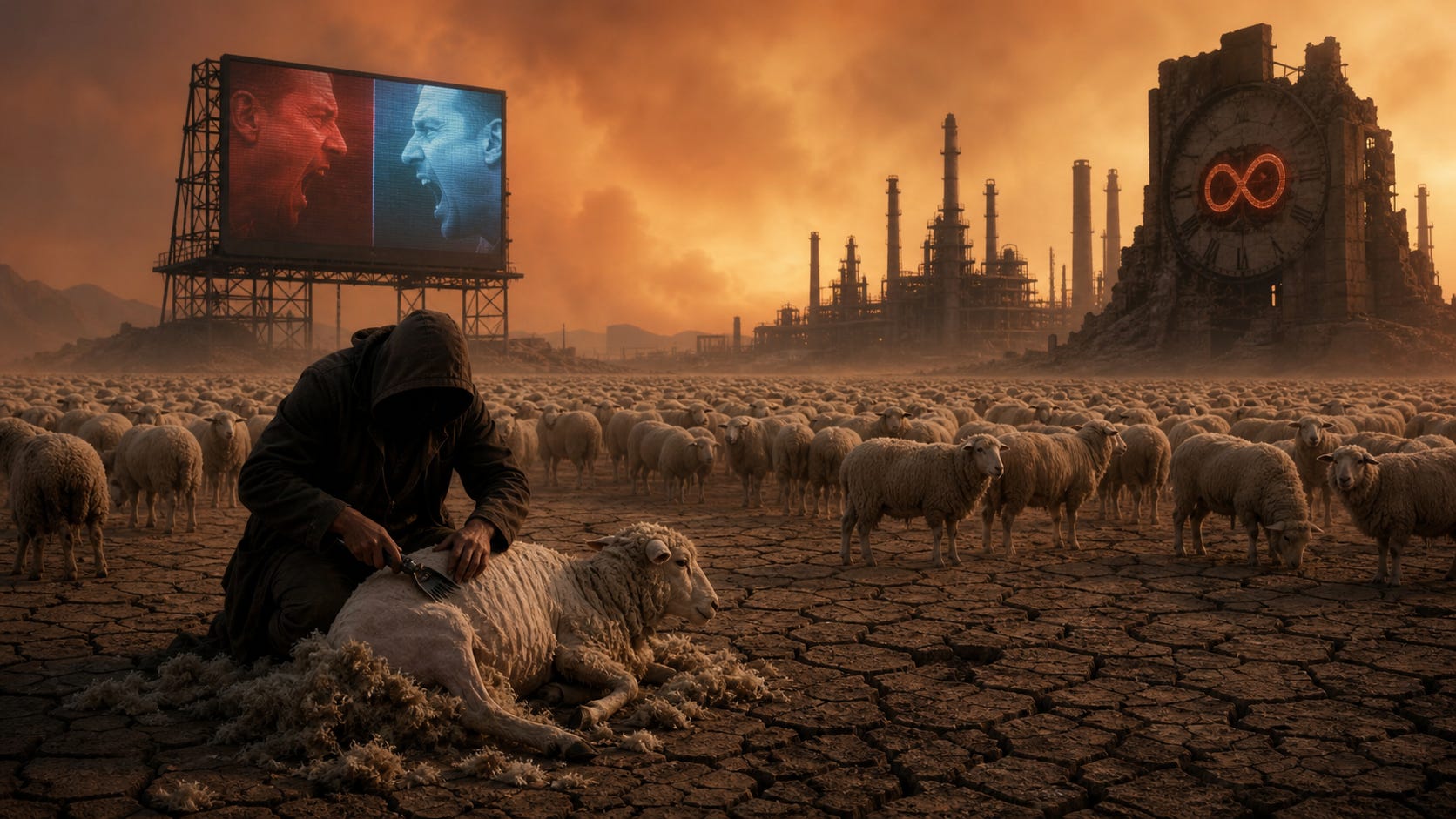
Watch the news. Scroll your feed for thirty seconds. Listen to how people talk to each other. Open Substack and you’ll notice the same pattern everywhere: ordinary people are being pulled into one of two psychological states — consuming fear or willful denial.
Ideas that once sounded fringe now circulate as plausible truths: microchips under the skin, chemtrails, depopulation vaccines, staged moon landings, FEMA camps, secret cabals, flat Earth theories, weather control, biolabs, hidden puppet masters. Some people become paranoid and permanently outraged. Others tune out completely, building comfort through avoidance.
What's disappearing is the middle: people who can hold ambiguity without collapsing into denial or certainty.
The Military Tactic Behind the Madness
Have you noticed the sheer number of stories out there? Here’s what most people don’t realize: this isn’t just chaos. These symptoms are deliberately induced by military and intelligence tactics.
To be precise, there are two distinct tactics at work here. The first is ambiguity increasing — a psyops strategy that floods the information environment with competing claims, making coordinated action impossible. The second is kompromat — the collection of compromising material to ensure individual compliance. Both serve the same masters. Both exploit the brain’s us‑vs‑them wiring. But they operate at different scales: ambiguity increasing targets populations; kompromat targets specific people.
In a 2021 interview, war correspondent Lara Logan put it perfectly. She was explaining why the U.S. withdrawal from Afghanistan seemed so incomprehensible — full of shifting narratives and contradictory blame — and then she named the strategy:
“They want you to believe that Afghanistan is complicated because if you complicate it, it’s a tactic in information warfare called ambiguity increasing.”
Confusion is not a side effect. Confusion is the weapon.
But confusion alone doesn’t trigger that tribal lockdown. Chronic, unresolved threat detection triggers it. When you cannot tell what is real, your brain cannot tell what is safe. Every new claim — vaccines are poison, the election was stolen, the Earth is flat — registers as a potential danger signal. The amygdala fires. Cortisol rises. And the brain, under pressure, starts drawing sharp lines: friend or enemy, true or false, ally or threat. No middle. No maybe.
That is how ambiguity increasing becomes a fight‑or‑flight weapon. It does not frighten you with a single monster. It frightens you with a world where monsters could be anywhere.
How ambiguity increasing works: You flood the public with so many competing stories, partial truths, and contradictory claims that no one can agree on what is real anymore. Every fact becomes debatable. Every event becomes a Rorschach test. For any given issue, there are a dozen plausible‑sounding explanations — some true, some false, most a mix of both.
Then you sit back and watch.
People argue past each other not because they’re stupid, but because they’re operating from completely different data sets. And the more they argue, the more entrenched they become.
The goal is not to convince anyone of one specific lie. The goal is to make all truth seem uncertain. When people cannot agree on basic facts, they become paralyzed, divided, and exhausted — kept in a low‑grade fight‑or-flight state. They stop acting. They stop trusting. They retreat into their tribes.
And when everyone is confused and fighting each other, those pulling the strings stay in control.
The Second Tactic: Kompromat
Logan also described the hierarchy behind information warfare:
“The way information warfare works is you have your people at the bottom who are your unwits — they have no idea what’s going on. Then you have your people in the middle layers who are your halfwits — they think they know what’s going on but they really don’t. And then you have your full wits at the top.”
Even the full wits may only know their piece of the puzzle. The system is designed so that almost no one sees the whole board.
Then she described what happens when someone tries to tell the truth:
“They get you in the dirt with their foot on your throat… and then they reach down and offer you a hand.”
That’s the kompromat control mechanism. Expose you. Humiliate you. Break your career. Then — if you comply — they lift you back up. According to Logan, General Stanley McChrystal took the hand, and General Michael Flynn did not.
This pattern is not limited to military affairs. Consider the case of Jeffrey Epstein. By now, it’s common knowledge that Epstein wasn’t just a wealthy sex offender — he was running an intelligence operation. Young girls were recruited to ensnare powerful men in compromising situations. Once the tapes existed, Epstein and his associates had leverage. They didn’t need to threaten openly. They just needed the targets to know: we have something on you.
That’s the foot on your throat. And then, for those who comply, the hand reaches down. You get rehabilitated. Your scandal gets memory‑holed. You’re invited back to the right parties, given the right media appearances. The system rewards cooperation and punishes truth‑telling.
Kompromat silences individuals. Ambiguity increasing paralyzes populations. Together, they form a complete cage.
The Energy Truth They Don’t Want You to See
What requires so much confusion and coercion to hide?
A simple answer: many analysts argue that we’re running out of cheap energy. Not just oil — the surplus that built modern civilization. And the people who run the system know it.
The “full wits” aren’t a single cabal. They’re a distributed network of institutions, financial interests, and political actors who understand two things: declining Energy Return on Investment (EROI) makes endless growth impossible, and a population that understood this would demand changes the system can’t easily absorb.
EROI asks one question: how much energy do you get out for each unit you put in?
Early oil was astonishing. One barrel invested returned 100 barrels or more. Gushers in Texas sprayed profit into the air. That near‑free surplus built everything: the Green Revolution, highways, suburbia, jet travel, plastics, the consumer economy.
Today, that ratio has collapsed. Conventional onshore oil returns 10–20 to 1. Tar sands and deep offshore: 3–5 to 1. Fracked shale hovers around 5 to 1 — and requires constant, expensive drilling just to stay level. Coal’s EROI has fallen steadily since the 1950s, with some models peaking globally between 2025 and 2045.
This isn’t opinion. It’s physics. We’ve burned the easy fuel. What’s left is harder, costlier, and delivers less net energy.
Here’s where finance enters. Gas prices rise and fall, but they never reflect the real effort to get oil out of the ground. That’s because the price at the pump isn’t set by EROI alone — it’s set by dollars, and dollars are mostly debt.
Most money is created when a bank issues a loan. That loan must be repaid with interest. To pay the interest, the economy must constantly grow. More debt, more spending, more energy. A treadmill.
When easy oil runs out, the next barrel costs more energy to produce. In a sane world, its price would rise until demand collapsed or alternatives appeared. But the debt system can’t tolerate a sustained energy price spike. Why? Because everything — food, transport, manufacturing, heating — depends on cheap energy. Double energy prices and stay there, and the cost of everything doubles. Profits vanish. Loans stop being repaid. The debt bubble pops.
So central banks step in. They lower rates, print money, subsidize production, and make it easier to borrow against future oil revenues. All of this artificially suppresses energy prices, keeping them below what true EROI would dictate.
Debt holds down the price of energy. Not forever — but long enough to keep the system running. Whenever oil prices start rising toward their genuine replacement cost, the financial system injects new credit. That credit lets producers keep drilling marginal wells, and consumers keep buying fuel they can’t afford. The gap between real cost and subsidized price is filled by debt.
The financial system and energy system are two legs of the same table. Take away debt, and the true cost of energy appears overnight. Some energy economists say gas wouldn’t be $5 a gallon. It could be $10, $15, $20 — if you could get it at all.
And if debt breaks, that artificially low price breaks with it. A cascading debt crisis triggers an energy price spike. An energy supply shock triggers a debt crisis. Either way, the system shatters.
That’s what ambiguity increasing and kompromat hide. Not one secret — but the fundamental fragility of a civilization built on cheap energy and endless debt.
Deeper Learning: Energy 101, 201, and 301
If this is new to you — or if you sense I’m oversimplifying — I encourage you to watch three short videos by Nate Hagens. Hagens is a former Wall Street energy analyst turned educator. He walks through the oil predicament with clarity and no partisan agenda.
Energy 101: What You Actually Need to Know About Oil — A primer on why oil matters more than politics.
Energy 201: What Happens When the Oil Stops Flowing — A look at the consequences of declining surplus.
Energy 301: The World After Cheap Energy — A sober exploration of what comes next.
After you watch them, ask yourself: if this reality were widely understood, how would politics change? What would happen to the stock market? To globalized supply chains? To the stories politicians tell us about “growth” and “recovery”?
Relearn Who You Can Trust
Trusting your tribe blindly while suspecting everyone else is a trap. But the deeper lie is that any tribe will save you. They won’t.
The system treats us like sheep — calm with low prices, distracted with outrage, shorn regularly, and eventually eaten. The moment you see that, your question changes. It’s no longer “Which side is right?” Instead, you start asking, “Who benefits when I stay confused and loyal?”
That question — who benefits? — changes everything.
The stories on the news need a clear enemy. But there is no single enemy. There is a system: a system built on cheap energy and endless debt. A system that requires you to believe in heroes and villains while the real story — collapsing Energy Return on Investment, and the debt bubble hiding the true cost of everything — stays buried beneath the noise.
So how do you break free? Relearn who you can trust. Start with a brutal rule:
Trust only what makes sense from a big-picture, nature-based view — not from a political narrative. Watch what they do, not what they say.
Trust patterns, not personalities. Does the same small group end up richer and more powerful no matter who “wins” the news cycle?
Trust energy and physics. The laws of thermodynamics have no political party. When someone says “we can grow forever on renewables,” ask for the EROI numbers. When they say “war is necessary,” ask who profits.
Distrust anyone who demands your outrage before you’ve had time to think. If a story makes you righteous and angry in ten seconds, assume you’re being played.
The hardest step is admitting that your own team — the one you’ve defended, whose flags you’ve waved — is also part of the shepherd system. Most of them don’t know it. Neither do you, most of the time. But the people at the top of your team are eating dinner with the people at the top of the other team. The fight on the screen is for you, not them.
Become the person who sees the shearing shed and the slaughterhouse for what they are — not with paranoia, but with clear, calm, big-picture vision. Step back from every daily firefight and ask one question over and over:
“What is being hidden by all this noise?”
Nine times out of ten, the answer is the same: the true cost of energy, and the debt that hides it.
Once you see that, you stop trusting anyone who benefits from your confusion. And that is almost everyone in power — on every “side.”
You won’t be popular. You’ll be called a conspiracy theorist by people still trapped in the old loops. But you’ll be sane. And sanity, right now, may be the most radical act there is.
If this work matters to you, please consider sharing it. And if you’d like to support my research and writing, paid subscriptions are available via Patreon, BuyMeACoffee, or Substack. Thank you for being here.
Thank you, Wendy. As someone who tries to get things done and/or changed and/or just left the Hell alone in my small city, the single biggest hurdle for me is getting people to let go of their polarities. Let’s say there’s trash on the beach that should be picked up but isn’t. Just get a group of people equally fed up with the unsanitary beach and do it. It doesn’t matter what they did last week, or who they voted for or whether they eat meat. All that matters is doing it. And that is why our small cities and towns are falling apart and becoming unlivable. Because the people at the top are geniuses at polarizing people into meaningless factions so that nothing gets done to just make life a little better today.
Hi Wendy. Thank you for another thought-provoking essay. I agree completely that the great faultline of our civilization is that the hydrocarbons running the show are becoming more difficult to extract and therefore more expensive, and cannot sustain the built-in requirement for growth the global economy demands. (Another way to look at it would be more and more energy goes toward obtaining more energy, whether that be building a massive concrete pad for a windmill or fracking tight oil from a well in the Permian basin, rather than toward building and maintaining infrastructure, producing consumer goods, etc.-- ie. growing the GDP. )
But is hiding that fact really the reason behind all the noise, the tactical deployment of “ambiguity increasing” as a weapon in the information war?
Nate Hagens is just the latest in a line of writers and researchers attempting to bring the oil situation to the forefront.I’ve been following the oil “situation” for over 20 years now (yikes), first through environmental concerns, then by following writers like John Michael Greer and Nicole Foss and Gail Tvorberg who emerged from the peak oil movement.
By the time I took a bus down to Washington, D.C. to get arrested in the 2012 XL pipeline protests, I was already feeling a lot of congnitive dissonance based on my understanding of EROEI and it’s relationship to the financial system, as well as Foss’ statement that "Any civilization that can produce solar panels can't be run on them." which encapsulates concepts like system complexity and embodied energy. So even while being handcuffed and shoved into the back of a police van, I could see the (unavoidable) hypocrisy of 350.org and similar environmental alarmist groups.
In the years that followed, I started to question the fundemental mythologies and histories of our world, so that, in 2020, I was ready for the covid op and subsequent lockdowns. No shot for me, thankyouverymuch. Any remaining doubts about questioning every single thing went completely away.
Which is to say, the facts about oil depletion, EROEI, collapse of complex systems, etc. have been out there for a long time–M. King Hubbert published his peak oil “theory” in 1956. (I put theory in quotes because oil being finite and therefore subject to a peak is a fact, not a theory. The theory part I suppose is speculating when that peak would occur. More on this in a moment.) Yet this is not common knowledge, as you rightly point out.
But is it really because of the increasing amount of conspiracy theories and binary arguments flooding the digital waves? Or is it maybe something else? Or a combination?
I suspect the biggest impediment to a wider understanding of the role oil plays in the fragile nature of our status quo is our complete faith as a society in the Myth of Perpetual Progress. (This is perfectly illustrated in this context by a line from the Wikipedia entry on Hubbert’s peak oil theory:
“The development of new technologies has provided access to large quantities of unconventional resources, and the boost in production has largely discounted Hubbert's prediction “ The entry also mentions BOE–Barrel of Oil Equivalent–which covers solar, wind, nuclear, etc., which I would say qualifies as ambiguity increasing.)
There is a certain, rather small segment of the population that apparently has the ability to dismantle this myth. Whether that has to do with some childhood trauma, a genetic disposition toward skepticism, or who knows, but it is not necessarily simply book learning; that will fail without the reception activated.
I have a number of intelligent friends who, for example, thought fracking was only about natural gas, and insist that solar and wind or nuclear fusion or some as yet undetermined energy source (talk about magical thinking!) will come along soon. So I don’t think all the ambiguity is generated for that main reason. But of course all the confusion helps with the achievement of many other goals desired by the PWB (People Who Benefit). You could look at it in relation to the shock doctrine and disaster capitalism
You say we should ask “Who benefits?” My question would then be, How, and Why? Is it just to gain more power and money? Is it to ultimately set in motion a massive die-off, so there will be more resources and many fewer humans? Certainly if the standoff in the Strait of Hormuz continues we will likely see mass starvation in many parts of the world.
Finally, in one of your comment replies you write:
“Better to figure out how to navigate the transition than focus on whether these narratives are true or not. It's like arguing how to arrange the furniture on the Titanic. Better to focus on how to get off before it sinks.”
Early on, I was studying permaculture, wondering about moving to a more rural area and homesteading, learning how to shoot, etc. Now I realize, I am in this particular time, and there is no jumping ship. The thing to do is to befriend the passengers next to you, and enjoy the band.
(By the way, spooky AI illustration! Looks like data centers are poised to be the next ambiguity increasing.)